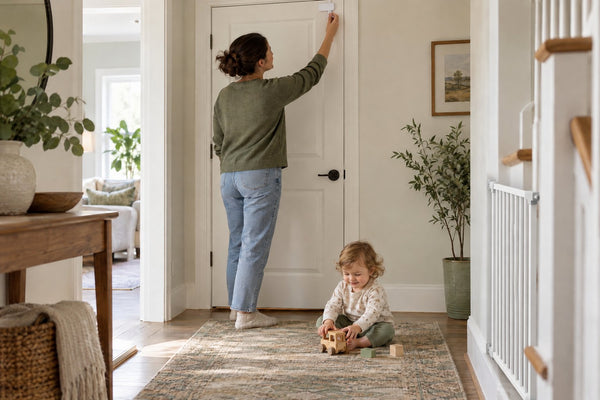
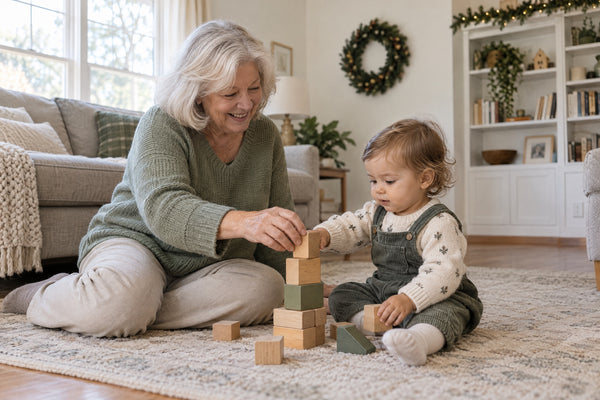
Quick answer: To toddler proof a Christmas tree, set it up away from heat and doorways on a stand that cannot tip, keep it watered if it is real, put breakable and small ornaments at the top and soft ones at the bottom, skip anything that looks like candy, check every light strand, and keep button batteries, holiday plants and candles out of reach. If your toddler cannot leave the tree alone, put a gate across the doorway or give them a safe play space while you are busy.
A Christmas tree is basically a giant, glittering toy that a toddler is told not to touch. Of course they want to touch it. Shiny balls look like candy, lights look like treasure, and the lower branches are exactly toddler height. You do not have to skip the tree this year. You just need a plan that works with your child's curiosity instead of against it.
This guide covers where to put the tree, how to decorate it from top to bottom, the hidden hazards elsewhere in the room, and what to do if your toddler simply will not leave it alone. For the rest of the house, our room-by-room babyproofing checklist has you covered.
Key takeaways
- Breakable and small ornaments go at the top. Soft, unbreakable ones go at the bottom.
- Skip decorations that look like candy or food. Toddlers will try to eat them.
- Button batteries in decorations, cards and remotes can cause life-threatening injuries if swallowed.
- Keep the tree away from fireplaces, radiators and heaters, and do not block doorways.
- A gate or a play space beats saying "no" all December.
Step 1: Choose the right spot
Where the tree stands matters as much as what is on it. The AAP's holiday decoration tips say to keep trees away from fireplaces, radiators and portable heaters, and not to block doorways.
- Away from heat: fireplaces, radiators, space heaters and heat vents.
- Out of walkways: not in a doorway or a busy path where it can be bumped.
- Near an outlet: so cords do not run across the floor.
- In a corner, if you can: two walls behind the tree means fewer sides for little hands to reach.
- Away from climbing helpers: move chairs, ottomans and step stools that could help a toddler reach higher branches.
Make the tree hard to tip
A toddler pulling on a branch can rock a tree. Use a sturdy stand that fits the trunk, set it on a flat floor and check that it does not wobble. Some families also tie the top of the tree to a hook in the wall or a heavy piece of furniture with clear fishing line. A smaller tree, or one on a solid table out of reach, is another option for the toddler years.
Real or artificial?
Both can work. If you buy a real tree, the AAP suggests choosing a fresh one with needles that are hard to pull off and do not break when you bend them, and keeping the stand filled with water. Safe Kids also advises watering natural trees regularly so the needles do not dry out and catch fire easily. If you choose an artificial tree, the CPSC and AAP both suggest looking for a "fire resistant" label. Keep the water in a tree stand covered or out of reach so a toddler cannot play in it.
Step 2: Decorate from the top down
Think of your tree in two zones: the grown up zone up high, and the toddler zone below.
| Zone | What goes there | Why |
|---|---|---|
| Top (above toddler reach) | Glass and breakable ornaments, heirlooms, anything with small parts or hooks | Safe Kids advises hanging breakable ornaments at the top of the tree |
| Middle | Lightweight plastic ornaments, ribbons tied on securely | Fine for a reach-and-pull toddler, not for mouthing |
| Bottom (toddler height) | Soft fabric or felt ornaments, sturdy wooden pieces, nothing small enough to choke on | The branches your child can reach should hold things that are safe to touch |
A few more rules from the AAP's holiday decoration tips:
- Avoid sharp or breakable decorations in homes with small children, and keep small removable parts out of reach.
- Avoid trimmings that look like candy or food. A toddler cannot tell a glittery gumdrop ornament from the real thing.
- Be cautious with trimmings that may contain lead. Choose plastic or nonleaded tinsel, keep light strands away from children who might mouth them, and wash your hands after handling lights.
- Use gloves with spun glass "angel hair", and follow the directions on artificial snow sprays.
Button batteries are the hidden danger. The AAP warns that button and lithium coin batteries can cause life-threatening injuries if swallowed. They hide in light-up ornaments, musical cards, remote controls and new toys. Check that battery compartments are secured, keep loose batteries locked away, and tape used ones before throwing them out. If you think your child swallowed one, get emergency care right away.
Step 3: Lights and cords
- Check every strand before you hang it, even new ones, for broken bulbs, frayed wires and loose connections, as the AAP suggests.
- Follow the limit on how many strands can be connected. The CPSC says never to string together more than three sets of incandescent lights, and never to overload outlets.
- Wrap lights deeper in the branches near the bottom so they are harder to pull.
- Hide the cords: run them behind the tree and along the wall, and cover the outlet or block it with furniture.
- Switch off the lights when you leave the house or go to bed, as Safe Kids recommends.
- Outdoors: use only lights certified for outdoor use, and hang them with hooks or insulated staples rather than nails.
Step 4: The rest of the holiday room
The tree gets the attention, but the room around it has its own hazards.
- Holiday plants: the AAP and Safe Kids both say to keep mistletoe, holly berries and other potentially poisonous plants out of reach. Save the Poison Help line in your phone: 1-800-222-1222.
- Candles: never leave a burning candle unattended, keep lit candles at least 12 inches from anything that can burn (Safe Kids), and never use lit candles on a tree or near evergreens (AAP). The CPSC suggests flameless candles when you can.
- Gifts and wrapping: clear away paper, bags, ribbons and bows after opening gifts. The AAP notes they can cause choking or suffocation, and fires near a fireplace.
- Toys for older kids: Safe Kids advises separating toys by age, since gifts for big siblings can have small parts.
- Visitors: guests bring handbags with medicines. Give every bag a spot up high. Our guide to babyproofing Grandma's house has more ideas for busy holiday gatherings.
If your toddler will not leave the tree alone
Some toddlers lose interest after a day. Others treat the tree like a full-time job. If yours is the second kind, the easiest fix is usually to separate the child and the tree, rather than guard every branch.
Option 1: Gate the room
If the tree is in a room with a doorway, a gate across the opening keeps it out of bounds while still letting your toddler see the lights. Gentle HugGate is a pressure-mounted gate for doorways, hallways and the bottom of the stairs, with one-hand opening. It is not for the top of the stairs: the CPSC says gates there must screw into the wall. Read our guide to pressure vs hardware mounted baby gates for where each type belongs.
Option 2: Give your toddler their own safe space
When you need to cook, wrap gifts or answer the door, a playpen gives your child a safe spot to play near you. Gentle HugYard is a soft play space with a thick mat that clips to the frame. It is for supervised play, not for sleep, so naps still happen in a crib or bassinet on a firm, flat surface. Put the playpen a good distance from the tree, cords and candles, so nothing can be reached through or over the sides. You will find both in our gates and play collection.
Option 3: Fence the tree
Some families put a barrier around the tree itself. If you try this, make sure it is sturdy, cannot be pushed into the tree or climbed, and does not create a gap a child can get stuck in. Keep watching, because a determined toddler will test it.
Whatever you choose, it helps to give your toddler a "yes" alongside the "no": a small unbreakable ornament to hold, a felt tree to decorate, or a nightly moment where you look at the lights together.
After the holidays
When the tree comes down, do a careful sweep for fallen needles, hooks, ornament caps and tinsel, which tend to turn up under furniture for weeks. Store decorations with batteries in a closed box up high. And if your toddler is on the move, our babyproofing timeline shows what to expect in the months ahead. You can read more about how we approach safety on our safety page.
Frequently asked questions
How do I keep my toddler away from the Christmas tree?
Put the tree in a corner away from heat and doorways, keep breakable ornaments up high, and use a gate across the doorway or a playpen for your toddler when you cannot watch closely.
Which ornaments are safe for toddlers?
At toddler height, use soft fabric or felt ornaments and sturdy pieces too big to choke on. Avoid glass, small parts, button batteries and anything that looks like candy or food.
Is a real or artificial tree safer with a toddler?
Both can be used safely. Keep a real tree fresh and watered, and look for a "fire resistant" label on an artificial tree. Either way, use a sturdy stand and keep it away from heat.
Can my baby nap in the playpen by the tree?
Only if it is a play yard that meets the safety standard for sleep, with nothing else inside. Gentle HugYard is for supervised play, not sleep, so naps belong in a crib, bassinet or sleep-approved play yard.
Sources
- American Academy of Pediatrics, HealthyChildren.org: Holiday Decoration Safety: 12 Tips for Families
- U.S. Consumer Product Safety Commission: Holiday Safety Information Center
- Safe Kids Worldwide: Holiday Safety Tips
- American Academy of Pediatrics, HealthyChildren.org: How to Keep Your Sleeping Baby Safe: AAP Policy Explained
Sources checked on October 27, 2026.
This guide is general information and is not medical advice. Our products help, and they never replace adult supervision. Talk with your pediatrician about your own child.