Quick answer: The American Academy of Pediatrics (AAP) suggests starting before or as soon as your baby begins crawling or walking. Begin with the hazards that cause the most serious injuries: furniture and TV tip-overs, stairs, windows, water, poisons and button batteries. Then go room by room, and recheck every few weeks as your child learns new skills.
Babyproofing lists can feel endless. This one is built to be calm: the serious things first, the small things after, and a short list of what you can skip. Every item comes from public guidance by the AAP, the U.S. Consumer Product Safety Commission (CPSC) and Safe Kids Worldwide, linked at the end. Not sure when to begin? Our month-by-month babyproofing timeline answers that first.
Key takeaways
- Do the big five first: anchor furniture and TVs, gate the stairs, secure windows, lock up poisons and medicines, and keep button batteries out of reach.
- Get down on the floor at your baby's eye level. You will spot things you never see from standing height.
- No product replaces an adult nearby. Products buy you seconds, not minutes.
- Recheck everything when your child starts crawling, pulling up, walking and climbing.
Start here: the big five
If you only have one afternoon, spend it on these. They are the hazards the AAP and CPSC come back to again and again.
- Anchor furniture and TVs. Bookcases, dressers and TV stands go to the wall with anti-tip devices. The AAP recommends metal anchors over plastic ones and mounting flat-screen TVs to the wall or to the furniture. The CPSC's Anchor It campaign also says to keep toys and remotes off the top of TVs and furniture, so kids are less tempted to climb.
- Gate the stairs. The AAP advises gates at the top and bottom of stairs once your child starts crawling. For the top of the stairs, the CPSC says to use only gates that screw into the wall. Our guide to pressure vs hardware mounted gates explains where each type is safe.
- Secure windows. Screens keep bugs out, not children in. The CPSC recommends window guards or stops that limit openings to 4 inches or less, while keeping at least one window per room usable as a fire escape. Move cribs, chairs and sofas away from windows.
- Lock up poisons and medicines. Keep cleaning products, detergent pods, medicines, vitamins, alcohol and vaping liquid up high and locked. The AAP reminds parents that child-resistant caps are not childproof. Save Poison Help in your phone: 1-800-222-1222.
- Find every button battery. Remotes, key fobs, watches, flashing toys and greeting cards can hold small coin batteries. The AAP says a swallowed battery is an emergency: go to the emergency room right away.
The floor test: lie on the floor in each room and look around. Coins, pills, beads, cords and loose outlet plates are much easier to see from down there. The AAP suggests exactly this habit.
Living room
This is where babies spend the most awake time, so it is usually the first room to finish.
- Anchor the TV, the TV stand and any bookcase or tall shelf.
- Cover unused outlets, or block them with heavy furniture. If outlets are being replaced, the CPSC suggests tamper-resistant ones.
- Move the coffee table out of walking paths, or add soft corner and edge guards.
- Choose cordless blinds. If you have corded ones, tie cords up high and out of reach.
- Put a screen around fireplaces, wood stoves and hot heaters.
- Keep houseplants out of reach until you know which ones are safe. Poison Control can tell you.
- Check the couch cushions and under the sofa for coins and small objects.
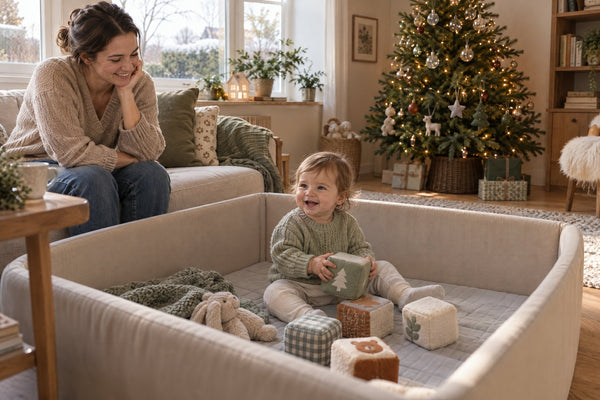
The Gentle Home Kit puts corner guards, cabinet locks and outlet covers in one box, with no screws. It helps with the everyday spots, and it does not make a room childproof on its own: you still need anchors for furniture and a plan for the stairs.
Kitchen
- Put safety latches on the cabinets that hold cleaners, dishwasher pods and sharp tools. Better still, move those items up high.
- Keep knives, scissors and the trash out of reach, or use a trash can with a child-resistant lid.
- Ask about anti-tip brackets for a freestanding range. The CPSC recommends them to prevent scalds and crushing injuries.
- Keep hot drinks away from table and counter edges, and never carry a hot drink while holding your child.
- Keep your child out of the kitchen while you cook, as the AAP suggests, or safely strapped into a high chair.
Bathroom
Water and medicines make the bathroom one of the rooms to lock first.
- Set your water heater so the hottest water at the faucet is no more than 120°F, as the AAP recommends. Test bath water with your wrist or elbow.
- Stay within arm's reach for the whole bath, every time. The AAP notes that bath seats and rings do not prevent drowning.
- Drain the tub as soon as bath time ends, and keep the toilet lid closed. A toilet lid lock helps.
- Store medicines and cosmetics high and locked.
- Unplug hair dryers and razors and store them away from water.
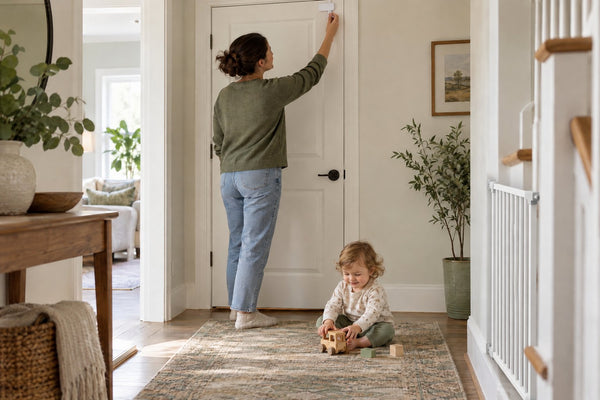
- Keep the bathroom door closed. A door lock up high, out of a toddler's reach, makes that easier.
For the door itself, Gentle Lock slips onto the top edge of a standard interior door by hand and lets adults open it from either side. It is not for exterior or fire doors, and it never replaces watching your child near water.
Nursery and bedrooms
- Follow the AAP safe sleep basics until the first birthday: baby on their back for every sleep, a firm, flat surface with a fitted sheet only, and nothing soft in the crib (no pillows, blankets, bumpers or stuffed toys).
- Share a room, not a bed, for at least the first 6 months.
- Anchor the dresser. Bedrooms are a common place for tip-overs.
- Move the crib away from windows, blind cords and wall decor.
- Keep a working smoke alarm outside every sleeping area and test it monthly.
Not for sleep: play yards used for play, head cushions, loungers and pillows are not sleep spaces. The only place for a baby to sleep is a crib, bassinet or play yard that meets CPSC sleep standards, set up as the AAP describes.
Stairs, hallways and doors
- Top of the stairs: a hardware-mounted gate screwed into the wall or banister, never a pressure gate.
- Bottom of the stairs: a hardware gate or a well-fitted pressure gate.
- Avoid old accordion-style gates with V-shaped openings. The CPSC warns they can trap a child's head and neck.
- Do not use a pet gate as a baby gate, as the CPSC advises.
- Keep doors to the basement, garage, laundry and bathroom closed and locked out of reach.
- Make sure every lock and knob cover lets an adult open the door quickly in an emergency.
For doorways, hallways and the bottom of the stairs, Gentle HugGate is a pressure-mounted gate you open with one hand. The top of the stairs needs a gate screwed into the wall, and we say that on every page.
Laundry room, garage and outside
- Store detergent pods in a closed, locked cabinet. Seal them after every use.
- Keep car keys and fobs (with their batteries) out of reach.
- Lock up tools, paints, antifreeze and garden chemicals in their original containers.
- If you have a pool, the AAP and Safe Kids recommend a fence on all four sides, at least 4 feet high, with a self-closing, self-latching gate.
- Empty buckets and wading pools right after use.
- If there is a gun in the home, the AAP advises storing it unloaded and locked, with ammunition locked separately.
What changes by age
| Stage | New skills | What to add |
|---|---|---|
| Before baby moves | Rolling, grabbing | Safe sleep set up, smoke alarms, water heater at 120°F, straps on in high chairs, swings and strollers, infant carriers on the floor and never on a table |
| Crawling | Reaching low cabinets, outlets, cords | Big five done, outlet covers, cabinet latches, gates at the stairs, floor test in every room |
| Pulling up and cruising | Grabbing table edges and shelves | Corner guards, anchors double-checked, cords out of reach |
| Walking and climbing | Opening doors and drawers, climbing furniture | Door locks up high, window stops, chairs away from counters and windows |
| Age 2 to 3 | Climbing over things, opening simple latches | Recheck every gate and lock, retire gates your child can climb or open |
Our babyproofing timeline goes month by month if you want more detail.
What you can skip (or wait on)
Not everything sold as babyproofing is needed in every home. A few honest notes:
- Rooms your child never enters can wait, as long as the door stays closed and locked.
- Baby walkers are worth skipping altogether. The AAP calls them a dangerous choice, and Safe Kids suggests a stationary activity center instead.
- Doubling up is rarely needed. If a cabinet is empty or holds only plastic containers, it may not need a latch at all.
The 10-minute monthly check
- Tug every anchor, latch and gate. Tighten or replace anything loose.
- Look for new climbing routes: a chair pushed near a counter, a toy box under a window.
- Test smoke and carbon monoxide alarms.
- Do the floor test again.
- Show sitters and grandparents how each lock and gate opens. The Gentle Root Safety page has the same habits we follow.
Renting? Most of this list works without drilling. See how to babyproof a rental without drilling, and what still needs a conversation with your landlord.
Frequently asked questions
What should I babyproof first?
Start with the hazards that cause the most serious injuries: anchor furniture and TVs, gate the stairs, secure windows, lock up poisons and medicines, and remove button batteries. Then move room by room, starting with the room your baby spends the most time in.
Do I need to babyproof the whole house?
No. Focus on the rooms your child can reach. Rooms you keep closed and locked can wait, as long as every caregiver keeps them that way.
How often should I check my babyproofing?
A quick check every few weeks, and a fuller one every time your child learns a new skill like crawling, pulling up, walking or climbing.
Can babyproofing replace supervision?
No. Locks, gates and covers slow children down and remove some hazards, but an adult nearby is still the most important safety step.
What temperature should my water heater be for a baby?
The AAP recommends setting it so the hottest water at the faucet is no more than 120°F.
Sources
- American Academy of Pediatrics, HealthyChildren.org: Home Safety: Tips for Families With Young Children
- American Academy of Pediatrics, HealthyChildren.org: Childproofing Your Home for Poisons
- American Academy of Pediatrics, HealthyChildren.org: Preventing Furniture and TV Tip-Overs
- American Academy of Pediatrics, HealthyChildren.org: 5 Bathroom Safety Tips for Infants and Young Children
- American Academy of Pediatrics, HealthyChildren.org: How Small Batteries Can Become Dangerous to Children
- American Academy of Pediatrics, HealthyChildren.org: How to Keep Your Sleeping Baby Safe: AAP Policy Explained
- American Academy of Pediatrics, HealthyChildren.org: Safety for Your Child: 1 to 2 Years
- U.S. Consumer Product Safety Commission: Childproofing Your Home
- U.S. Consumer Product Safety Commission: Anchor It
- Safe Kids Worldwide: Home Safety Tips (PDF)
- Safe Kids Worldwide: Fall Prevention Tips (PDF)
Sources checked on October 27, 2026.
This guide is general information and is not medical advice. Our products help, and they never replace adult supervision. Talk with your pediatrician about your own child.