Quick answer: You can babyproof most of a rental without drilling: door top locks that slip on by hand, adhesive cabinet latches and corner guards, outlet covers, pressure-mounted gates for doorways and the bottom of the stairs, and smart furniture placement. Two jobs still need hardware: the CPSC says a gate at the top of the stairs must screw into the wall, and the AAP suggests asking your landlord before anchoring furniture.
Renting with a baby comes with an extra worry: you want a safe home, and you also want your deposit back. The good news is that most babyproofing can be done with no tools at all. The honest news is that a couple of the most important jobs are worth a conversation with your landlord. This guide covers both. If you are starting from zero, our room-by-room babyproofing checklist is the full list, and this guide shows how to do it in a rental.
Key takeaways
- Most babyproofing works without drilling: doors, cabinets, outlets, corners, doorways and the bottom of the stairs.
- Never use a pressure gate at the top of the stairs, rental or not. That gate needs screws.
- Anchoring furniture and TVs matters too much to skip. Ask your landlord, in writing.
- Test adhesive products on a hidden spot first, and follow the set time in the instructions.
What works without drilling
| Job | No-drill option | Good to know |
|---|---|---|
| Keep a toddler out of a room | A door top lock that slips onto the door by hand | For standard interior doors. Adults must be able to open it quickly in an emergency |
| Cabinets and drawers | Adhesive latches, or move hazards up high | Clean, dry surface, and the full set time before the first tug |
| Outlets | Plug-in covers, or furniture in front | The CPSC says covers should be hard for kids to remove and too big to choke on |
| Table corners | Soft adhesive corner guards, or move the table | The AAP suggests moving hazardous furniture out of walking paths |
| Doorways and hallways | A pressure-mounted gate | Fit it tight and check it often |
| Bottom of the stairs | A pressure-mounted gate, fitted tight | Never at the top of the stairs |
| Blind cords | Tie cords up high, or switch to cordless shades | The CPSC recommends cordless coverings in homes with young children |
| Poisons and medicines | Move them up high and into a locked box or cabinet | Child-resistant caps are not childproof |
Doors: keep the bathroom, laundry and basement closed
Doors are one of the easiest wins in a rental. Many toddlers learn to open door handles, and the rooms behind them (bathroom, laundry, basement, home office) hold some of the biggest hazards in the house.
- Choose locks that sit up high, out of reach, rather than at handle height where a toddler can work on them.
- Pick a lock an adult can open quickly from both sides. The CPSC says door knob covers and locks must let an adult open the door fast in an emergency.
- Skip locks on exterior doors and fire doors.
- Show every caregiver how each lock opens.
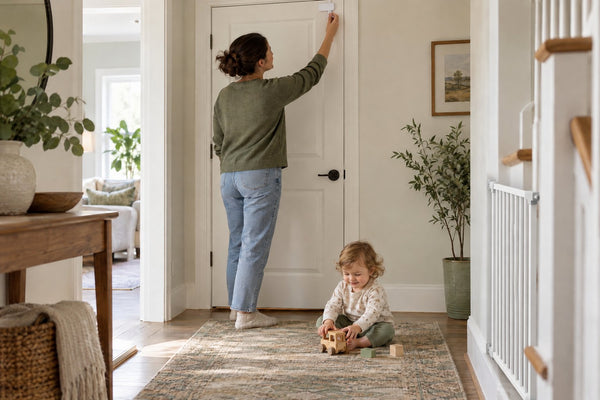
Gentle Lock was made for this: it slips onto the handle side edge of a standard interior door by hand, with no tools, no drilling and no adhesive. When the door closes, the spring latch catches on the frame; adults open it from either side. It slides off when you move out. It is not for exterior or fire doors, and it never replaces keeping an eye on your child. See all our options in the door collection.
Cabinets, outlets and corners
These are the spots little explorers find first, and they are the easiest to do without tools.
- Cabinets: first, move cleaners, detergent pods, medicines and sharp tools up high. Then latch the low cabinets that still hold anything harmful.
- Outlets: cover the ones you do not use, or put heavy furniture in front of them, as the AAP suggests.
- Corners: move the coffee table out of the main walking path, or add soft guards to the corners at your child's head height.
Protect your deposit: before you stick anything on painted walls or wood, try one piece on a hidden spot. Clean the surface, press firmly, and wait the full set time in the instructions. When you move out, warm old adhesive gently and peel slowly.
The Gentle Home Kit puts corner guards, cabinet locks and outlet covers in one box, with no screws. It helps with the everyday spots. It does not make a room childproof on its own, and it does not anchor furniture.
Gates: where a pressure gate is fine, and where it is not
Pressure-mounted gates are the renter's best friend for doorways, hallways and the bottom of the stairs. They hold in place by pressing against the walls, so there are no holes.
Never at the top of the stairs. A pressure gate can be pushed out of place. The CPSC says that for the top of stairs, you should only use gates that screw to the wall. In a rental, that means asking your landlord. It is the one place where "no drilling" is the wrong answer.
A few more rules from the CPSC: use gates that meet current safety standards, avoid old accordion gates with V-shaped openings, and never use a pet gate as a baby gate. Our full guide to pressure vs hardware mounted baby gates explains where each type is safe.
Gentle HugGate is pressure-mounted with silicone wall pads, made for doorways, hallways and the bottom of the stairs. Follow the fitting steps in the instructions, check that it is tight every few weeks, and stop using it when your child can climb over or open it.
Anchoring furniture: the job worth asking about
Furniture and TV tip-overs are one of the hazards the AAP and CPSC stress the most. Anchoring means a small screw into the wall, which is why renters often skip it. Please do not.
- Ask your landlord. The AAP suggests asking for permission and explaining that it is for childproofing. Put the request in writing and keep the reply.
- Offer to patch the holes when you move out. Small anchor holes are usually quick to fill.
- Use metal anchors, such as L brackets, rather than plastic ones, as the AAP recommends, and install any anti-tip kit that came with a new dresser right away.
- Mount flat-screen TVs to the wall or to the furniture, or use an anti-tip strap.
- While you wait: move heavy items to bottom drawers, take toys and remotes off the top of furniture (the CPSC's Anchor It campaign advises this), and keep your child out of rooms with unanchored furniture.
Step-by-step help is on the CPSC's Anchor It page.
Windows
Window screens keep bugs out, not children in. The CPSC recommends window guards or stops that keep openings to 4 inches or less, while keeping one window per room usable as a fire escape. Many guards and stops need screws, so this is another item for your landlord conversation. In the meantime, open windows from the top if you can, as Safe Kids suggests, and move cribs, chairs and sofas away from windows so there is nothing to climb.
How to ask your landlord
Keep it short and specific. Something like:
"Hi, we have a baby who is starting to crawl. To childproof the apartment, we would like to (1) anchor the dresser and bookcase to the wall with small brackets, and (2) install a hardware-mounted safety gate at the top of the stairs. We will patch and paint any holes when we move out. Is that OK with you?"
Ask in writing, keep the answer, and take photos of the walls before and after. If the answer is no, ask whether the landlord would install the items, and keep your child out of the areas that are not safe yet.
Moving out without a trace
- Slide off door top locks and pressure gates. Keep the instructions for next time.
- Remove adhesive pieces slowly, following the product's instructions.
- Patch any anchor holes you agreed on.
- Before you leave, babyproof the next home with the same list. Our babyproofing timeline helps you see what your child needs at their new stage.
Frequently asked questions
Can you babyproof without drilling?
Mostly, yes. Door top locks, adhesive latches and corner guards, outlet covers and pressure gates for doorways and the bottom of the stairs all work without drilling. A gate at the top of the stairs and furniture anchors still need screws.
Can I use a pressure gate at the top of the stairs in a rental?
No. The CPSC says to use only gates that screw into the wall at the top of the stairs. Ask your landlord for permission to install one.
Do I need my landlord's permission to anchor furniture?
Usually you should ask, since it means small holes in the wall. The AAP suggests asking and explaining that it is for childproofing.
Will adhesive babyproofing damage my walls?
It can, depending on the surface and the product. Test on a hidden spot first, follow the surface prep and set time, and remove pieces slowly when you move out.
Sources
- U.S. Consumer Product Safety Commission: Childproofing Your Home
- U.S. Consumer Product Safety Commission: Anchor It
- American Academy of Pediatrics, HealthyChildren.org: Preventing Furniture and TV Tip-Overs
- American Academy of Pediatrics, HealthyChildren.org: Home Safety: Tips for Families With Young Children
- American Academy of Pediatrics, HealthyChildren.org: Childproofing Your Home for Poisons
- Safe Kids Worldwide: Fall Prevention Tips (PDF)
- Safe Kids Worldwide: Home Safety Tips (PDF)
Sources checked on October 27, 2026.
This guide is general information and is not medical advice. Our products help, and they never replace adult supervision. Talk with your pediatrician about your own child.