Quick answer: To keep a toddler out of a room, close the door and add something they cannot work but an adult can open in seconds: a door top lock mounted up high, a door knob or lever cover, or a gate across the doorway. The CPSC recommends door knob covers and door locks for hazardous rooms, as long as an adult can open the door quickly in an emergency. Use them to keep children out of risky rooms, never to shut a child in.
There is a moment every parent remembers: the day your toddler reaches up, grabs the door handle and walks into the bathroom on their own. Doors used to be walls. Now they are just suggestions. The good news is that keeping a toddler out of a room is one of the easier babyproofing jobs, once you know which tool fits which door.
This guide covers which rooms to close off, the options that work (with and without tools), how to choose, and the safety rules that matter more than any product. If you are babyproofing the whole home, start with our room-by-room babyproofing checklist.
Key takeaways
- Close off rooms with water, chemicals, medicines, tools or heavy furniture you cannot anchor yet.
- Whatever you choose, an adult must be able to open the door quickly from the outside in an emergency.
- Locks are for keeping a child out of a hazard, not for locking a child into a room.
- A door top lock works on most interior doors, including lever handles that knob covers do not fit.
- No lock replaces supervision. Toddlers learn fast, so check every few weeks that your setup still works.
Which rooms to keep a toddler out of
You do not need to lock every door. Focus on the rooms where a few unsupervised minutes could go badly:
| Room | Why | What experts say |
|---|---|---|
| Bathroom | Water, medicines, razors, cleaners | Safe Kids advises keeping bathroom doors closed and toilet lids down to prevent drowning |
| Laundry room | Detergents, open washers and buckets of water | Safe Kids advises keeping laundry room doors closed |
| Garage and basement | Tools, car fluids, garden chemicals | The CPSC suggests locks to keep children away from hazardous rooms |
| Home office or craft room | Cords, chargers, button batteries, scissors, small parts | Easier to close the door than to babyproof every drawer |
| Guest room or storage room | Unanchored furniture, boxes, things you have not sorted yet | Keep children out until furniture is anchored |
Kitchens are harder, because most have no door. There, a gate across the doorway and cabinet latches do the job instead. Our guide to pressure vs hardware mounted baby gates explains where each gate type is safe.
Your options, compared
| Option | Works on | Install | Good to know |
|---|---|---|---|
| Door top lock | Most standard hinged interior doors, with knobs or levers | Often by hand, no tools | Sits above a toddler's reach. Adults open it with one hand |
| Door knob cover | Round knobs only | Snaps over the knob | Some adults find them awkward. Must be sturdy and quick for an adult to open |
| Lever handle lock | Lever handles | Adhesive or clamp, depending on model | Toddlers can sometimes hang on levers. Check the fit |
| Hook and eye latch | Most doors | Screws into door and frame | Permanent. Mount it high and make sure it opens fast from the outside |
| Gate in the doorway | Openings, including rooms with no door | Pressure or hardware mounted | Lets you see and hear the child. Toddlers may learn to climb it |
Whatever you pick, the CPSC's rule is the one to remember: the device should be sturdy and still let an adult open the door quickly in an emergency.
Why a door top lock is often the simplest answer
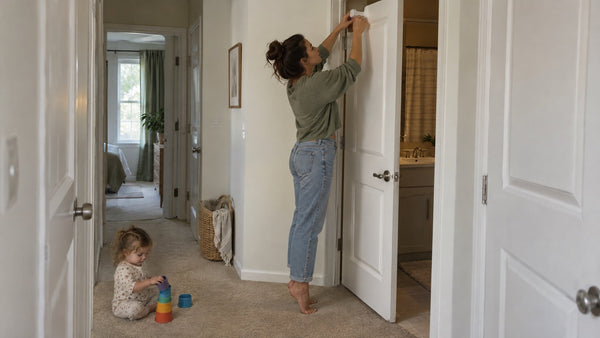
A door top lock sits at the top edge of the door, on the handle side, well above where a toddler can reach. When you close the door, the latch catches on the frame. To open it, an adult reaches up and releases it. Because it does not touch the handle, it works the same on round knobs and lever handles, which is where many knob covers fall short.
Gentle Lock is our door top lock. It slips onto the handle side edge of a standard hinged interior door by hand, with no tools, no drilling and no adhesive. Grown ups can open it from both sides: push the latch back with your thumb, or pull the slider on the other side. A small lever switches it off when you want the door to swing freely for the day, and it slides off when the curious years are over, which is handy in a rental. It is not for exterior doors or fire doors, and it is not a substitute for adult supervision.
How to fit a door top lock well
- Check the door type. Standard hinged interior doors only. Not sliding doors, pocket doors, exterior doors or fire doors.
- Read the fit notes. Door thickness and the gap between the door and the frame vary from home to home. Follow the instructions for your lock.
- Test it ten times. Close the door gently and firmly, push and pull from the toddler's side, then open it from both sides yourself.
- Check that everyone can open it. Every adult in the home, plus babysitters and grandparents, should be able to open it quickly without help.
- Recheck every few weeks. Doors get slammed, and toddlers grow. Make sure the latch still catches and is still out of reach.
See the doors collection for everything we make for doors.
The most important rule: out, not in
The title of this guide says "without locking anyone in" on purpose. Door locks are for keeping a child out of a room with hazards. We do not recommend using a lock to keep a child shut inside a room, including a bedroom at night. In a fire or another emergency, adults need to reach a child fast, and Safe Kids advises families to plan two ways out of every room.
- Make sure an adult can open every locked door from the hallway side in seconds.
- Never lock a door while a child is inside the room.
- Check rooms before you close and latch them. Toddlers love to hide.
- If bedtime wandering is the real problem, talk to your pediatrician about safe options for your child's age.
When the room has no door
Open-plan kitchens, archways and wide openings need a gate rather than a lock. A pressure-mounted gate like Gentle HugGate works in doorways, hallways and at the bottom of the stairs, with no drilling. The CPSC says that at the top of the stairs you should only use gates that screw to the wall, so never use a pressure gate there. Browse the gates and play collection for more.
If you rent
Door top locks that slip on by hand and pressure gates for doorways both come off without a trace, which makes them renter friendly. Hook and eye latches and hardware-mounted gates need screws, so ask your landlord first. Our guide to babyproofing a rental without drilling has a sample message you can send.
When to start, and when to stop
Most families add door locks when their baby starts crawling and pulling up, and get more serious once their toddler can reach handles. Our babyproofing timeline walks through each stage. Stop using a lock when your child can open it, climb to it or move furniture to reach it. At that point, the lesson shifts to house rules, and hazards go up high or behind a real lock.
Common mistakes to avoid
- Relying on a closed door alone. Toddlers often learn to open door handles sooner than parents expect.
- Using a knob cover on a lever handle it was not designed for.
- Leaving a step stool, chair or toy box near the door, which turns "out of reach" into "within reach".
- Forgetting the bathroom when guests visit. Ask them to close the door and put the toilet lid down.
- Treating a lock as a babysitter. It buys you time, not supervision.
To see how we think about product safety, visit our safety page.
Frequently asked questions
How do I keep my toddler out of the bathroom?
Keep the bathroom door closed with a door top lock, knob cover or lever lock that an adult can open quickly, and keep the toilet lid down. Safe Kids advises keeping bathroom doors closed to prevent drowning. Medicines and razors should still be locked up high.
Are door top locks safe?
Used as intended, on standard interior doors and to keep a child out of a hazardous room, a door top lock is a common choice. Make sure every adult can open it quickly from both sides, and never use it to lock a child inside a room.
Do door knob covers work on lever handles?
Usually not. Round knob covers are made for round knobs. For lever handles, use a lever lock made for them or a door top lock, which does not touch the handle at all.
Can I lock my toddler in their bedroom at night?
We do not recommend it. Adults need to reach a child quickly in an emergency, such as a fire. If your child wanders at night, talk to your pediatrician about safe options.
Sources
- U.S. Consumer Product Safety Commission: Childproofing Your Home
- American Academy of Pediatrics, HealthyChildren.org: Home Safety: Tips for Families With Young Children
- Safe Kids Worldwide: Home Safety Tips (PDF)
Sources checked on October 27, 2026.
This guide is general information and is not medical advice. Our products help, and they never replace adult supervision. Talk with your pediatrician about your own child.