Quick answer: The American Academy of Pediatrics (AAP) recommends childproofing before or as soon as your child begins crawling or walking. In practice, that means doing the big jobs (anchoring furniture, gating stairs, locking up poisons) a few weeks before your baby starts to move, then adding to them as each new skill shows up.
There is no single babyproofing day. Your home needs a little more attention each time your baby learns something new: rolling, crawling, pulling up, walking, climbing, opening doors. This timeline follows those skills, not the calendar, because every baby moves at their own pace. For the full room-by-room list, keep our calm babyproofing checklist open next to this one.
Key takeaways
- Start the big jobs before your baby can move on their own. Babies often get somewhere new faster than parents expect.
- Watch the skill, not the birthday. The ages below are rough and vary a lot from child to child.
- Each new skill means a quick walk-through of your home from your child's height.
- No stage replaces supervision. Products help, adults keep watch.
Before your baby moves: the newborn months
Your newborn cannot reach much yet, so this stage is about the basics that protect them wherever they are.
- Safe sleep. The AAP recommends placing your baby on their back for every sleep, on a firm, flat surface with only a fitted sheet, and keeping pillows, blankets, bumpers and stuffed toys out of the crib. Share a room, not a bed, for at least the first 6 months.
- Smoke and carbon monoxide alarms on every level and outside sleeping areas, tested monthly, as the AAP advises.
- Water heater set so the hottest water at the faucet is no more than 120°F.
- Straps and carriers. Safe Kids reminds parents to keep babies strapped into high chairs, swings and strollers, and to place an infant carrier on the floor, never on a table or other furniture.
- Poison Help saved in your phone: 1-800-222-1222.
This is also the calmest time to plan the bigger jobs. You have more time now than you will once your baby is on the move.
Rolling and grabbing
Once babies roll, they can end up somewhere you did not put them. Once they grab, anything within arm's reach becomes interesting.
- Never leave your baby alone on a bed, sofa or changing table, even for a moment.
- Keep hot drinks away from table edges and never hold a hot drink while holding your baby.
- Look for small objects on the floor and low surfaces: coins, beads, pills, button batteries.
- Choose cordless window coverings, or tie cords up high. The CPSC recommends cordless coverings in homes with young children.
A few weeks before crawling: the big jobs
This is the stage the AAP points to. Do these before your baby can get across a room on their own.
- Anchor furniture and TVs to the wall: dressers, bookcases, TV stands. The CPSC's Anchor It campaign has step-by-step help.
- Gate the stairs at the top and bottom. The top of the stairs needs a hardware-mounted gate screwed into the wall. Our guide to pressure and hardware mounted gates explains why.
- Lock up poisons. Cleaners, detergent pods, medicines and vitamins go up high and locked. Child-resistant caps are not childproof.
- Cover outlets that are not in use, or block them with furniture.
- Latch low cabinets that hold anything harmful, or move those items up high.
- Do the floor test: lie down in each room and look at what is within reach.
The Gentle Home Kit covers the outlets, cabinets and table corners in one box without screws, which makes this stage quicker. It does not anchor furniture or replace a gate.
Crawling
Crawlers explore at floor level and head straight for anything new. Expect to find hazards you missed.
- Walk through each room again at crawling height.
- Keep bathroom and laundry doors closed. Safe Kids recommends keeping doors to bathrooms and laundry rooms closed, and toilet lids down.
- Skip baby walkers. The AAP calls them a dangerous choice, and Safe Kids suggests a stationary activity center instead.
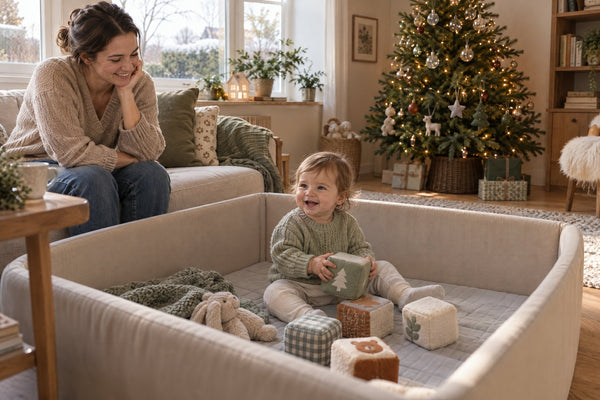
- Give your baby a safe, clear space on the floor where you can sit with them.
Pulling up and cruising
Standing babies grab table edges, shelves and anything that hangs down.
- Add soft corner guards to low tables, or move them out of walking paths. The AAP suggests cushioned corner and edge protectors.
- Check every anchor again. A standing baby pulls on furniture.
- Move chairs and stools away from counters and windows.
Walking and climbing
Walking toddlers reach higher, move faster and start to climb. The AAP's guidance for ages 1 to 2 focuses on falls, burns, poisons and water.
- Lock doors to rooms with hazards, and use gates on stairways.
- Install window guards above the first floor, or stops so windows open no more than 4 inches, as the CPSC and Safe Kids recommend.
- Keep your toddler out of the kitchen while you cook.
- Stay within arm's length around any water. The AAP notes a child can drown in less than 2 inches of water.
- Empty buckets right after use.
Opening doors and climbing over things (around age 2 to 3)
Many toddlers figure out door handles and simple latches around this stage. Locks that worked at 12 months may not work now.
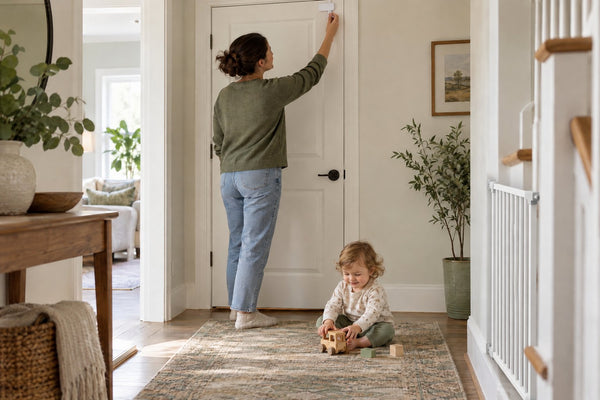
- Move door locks up high, out of reach. Gentle Lock slips onto the top edge of a standard interior door by hand, and adults open it from either side. It is not for exterior or fire doors.
- Recheck every gate. Stop using a gate your child can climb over or open.
- Look for new climbing routes: a toy box under a window, a chair next to the counter.
- Keep medicines locked, even "just for a minute" on the counter.
Want help choosing the right lock for each door? Browse our door collection.
The timeline at a glance
| Stage | What to have done |
|---|---|
| Newborn | Safe sleep, alarms, water heater at 120°F, Poison Help saved, straps on |
| Rolling and grabbing | Never alone on high surfaces, hot drinks away, small objects off the floor, cordless blinds |
| Before crawling | Furniture anchored, stairs gated, poisons locked, outlets covered, low cabinets latched |
| Crawling | Floor test again, bathroom and laundry doors closed, no baby walker |
| Pulling up | Corner guards, anchors rechecked, climbing aids moved |
| Walking and climbing | Door locks, window guards or stops, kitchen rules, water rules |
| Age 2 to 3 | Locks up high, gates checked or retired, new climbing routes removed |
If you rent or move often
Most of this timeline works without drilling. Anchoring furniture is the exception that matters most: the AAP suggests asking your landlord for permission and explaining that it is for childproofing. Our guide to babyproofing a rental without drilling covers the rest.
Frequently asked questions
When should I start babyproofing?
The AAP recommends starting before or as soon as your child begins crawling or walking. Many parents do the big jobs a few weeks before their baby starts to crawl, so nothing is rushed.
Is it too early to babyproof during pregnancy?
No. Safe sleep, smoke alarms and the water heater setting matter from day one. The rest can be planned during pregnancy and installed later.
My baby is already crawling. Am I late?
You are not late. Start with the big five today: anchor furniture and TVs, gate the stairs, secure windows, lock up poisons and medicines, and remove button batteries.
When can I stop babyproofing?
There is no fixed date. Retire each product when your child can open or climb it, or outgrows it, and keep the basics like anchored furniture and locked-up medicines for years.
Sources
- American Academy of Pediatrics, HealthyChildren.org: Childproofing Your Home for Poisons
- American Academy of Pediatrics, HealthyChildren.org: Home Safety: Tips for Families With Young Children
- American Academy of Pediatrics, HealthyChildren.org: How to Keep Your Sleeping Baby Safe: AAP Policy Explained
- American Academy of Pediatrics, HealthyChildren.org: Safety for Your Child: 1 to 2 Years
- American Academy of Pediatrics, HealthyChildren.org: Safety for Your Child: 2 to 4 Years
- American Academy of Pediatrics, HealthyChildren.org: Preventing Furniture and TV Tip-Overs
- American Academy of Pediatrics, HealthyChildren.org: Baby Walkers: A Dangerous Choice
- U.S. Consumer Product Safety Commission: Childproofing Your Home
- U.S. Consumer Product Safety Commission: Anchor It
- Safe Kids Worldwide: Home Safety Tips (PDF)
- Safe Kids Worldwide: Fall Prevention Tips (PDF)
Sources checked on October 27, 2026.
This guide is general information and is not medical advice. Our products help, and they never replace adult supervision. Talk with your pediatrician about your own child.