Quick answer: Before a holiday visit, spend 15 minutes on the hazards that matter most: put every medicine, purse and guest bag up high and out of sight, block the stairs, close off rooms you cannot make safe, check outlets and cords at toddler height, and plan a safe place for the baby to sleep. The AAP's tips for grandparents cover the same ground, and you can do the rest as the visit goes on.
Grandma's house is full of love, good food and things a toddler has never seen before. It is also a home that stopped being babyproofed decades ago, if it ever was. Pill organizers on the nightstand, a dish of candy on the coffee table, open stairs and a cabinet full of cleaners under the sink are all normal in a home without small children. None of this means anyone did something wrong. It just means the house needs a quick once-over before the little ones arrive.
This plan is written for both sides: parents who want to help without offending anyone, and grandparents who want the visit to be relaxed. If you want the full list for your own home, our room-by-room babyproofing checklist covers everything. This guide is the short, travel-size version.
Key takeaways
- Medicines are the first job. Purses, coat pockets and guest bags count too.
- Stairs need a gate or a closed door. A pressure gate is fine at the bottom of the stairs, never at the top.
- Close the doors to rooms you cannot make safe, like the garage, the office or the laundry.
- The baby sleeps on their back, alone, on a firm flat surface. Not in Grandpa's bed and not on the couch.
- One adult is always "on watch". Busy holidays are when supervision slips.
Start with a friendly conversation
Many grandparents raised children before outlet covers and cabinet latches were common, and some feel a little judged when the babyproofing talk comes up. Keep it warm and practical. Something like "We would love to come early and do a quick safety walk with you, so nobody has to worry during dinner" usually lands well. Offer to bring the supplies, and offer to take them back home afterwards if they prefer.
A few things to ask ahead of time:
- Where are the medicines kept, including vitamins, pill organizers and anything in a handbag?
- Are there stairs, and is there a door or gate at the top and bottom?
- Where will the baby sleep, and is there a crib or play yard that meets current standards?
- Are there pets, and where do their food and water bowls live?
- Are there any guns in the home, and how are they stored? The answer should be locked and unloaded, with ammunition locked separately.
The 15-minute plan, room by room
Do this on your hands and knees if you can. Toddler height is the only height that matters.
Minutes 1 to 4: medicines and bags
The AAP's tips for grandparents put medicines near the top of the list: keep them out of sight and reach, in child-resistant containers, and keep purses and bags that hold medicines away from grandchildren. Child-resistant caps slow a child down. They do not stop one.
- Collect pill organizers, vitamins, inhalers and creams from nightstands, counters and the kitchen table.
- Put them in one high cabinet, ideally one that locks, or in a lockable box.
- Choose a "bag spot" up high, like a closet shelf, for every guest's handbag and backpack. Holidays mean extra visitors with extra bags.
- Save the Poison Help line in every adult's phone: 1-800-222-1222.
Minutes 5 to 7: stairs and doors
Stairs are where a quick fix really pays off. The AAP suggests gates at the top and bottom of the stairs. The CPSC is specific about the top: only use gates that screw to the wall there. A pressure-mounted gate can be pushed out of place, so it belongs at the bottom of the stairs or in a doorway, never at the top.
No gate for the top of the stairs? Keep the door to the staircase closed, or keep the child in rooms away from the stairs, and make sure an adult is always with them. Do not improvise with a pressure gate at the top.
Our guide to pressure vs hardware mounted baby gates explains where each type is safe. Gentle HugGate is a pressure-mounted gate for doorways, hallways and the bottom of the stairs.
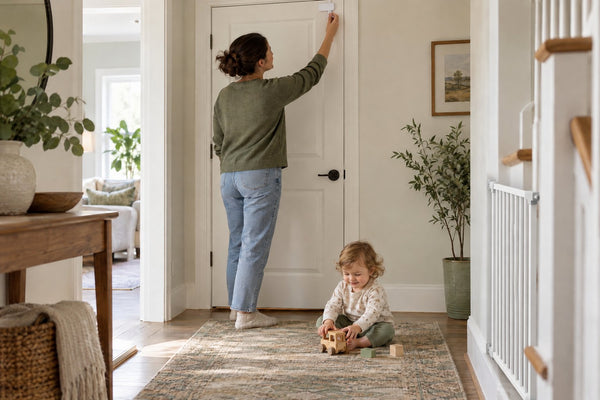
Next, close off rooms you cannot make safe in 15 minutes: the garage, a home office, a sewing room, the laundry room or a bathroom with a lot of medicine. The CPSC suggests door knob covers and door locks to keep children away from hazardous rooms, as long as an adult can open the door quickly in an emergency. A door top lock like Gentle Lock slips onto a standard interior door by hand, with no screws, and comes off again when you leave. That makes it a good fit for a house that is only "baby season" a few times a year. For more ideas, see the doors collection.
Minutes 8 to 10: the living room at toddler height
- Small things: candy dishes, nuts, coins, holiday decorations, hearing aid batteries and remote controls. Button batteries are a serious hazard, and the AAP lists keeping them away from children among its tips for grandparents.
- Outlets: plug covers that are hard for a child to remove and too big to choke on, as the CPSC recommends, or a piece of furniture in front.
- Sharp corners: the AAP suggests soft covers on sharp or solid furniture, or simply move the coffee table aside for the weekend.
- Heavy things that can tip: TVs on stands, bookcases and dressers. The CPSC recommends anchoring them. If that is not possible this visit, take toys and remotes off the top so nothing tempts a climber, and keep the child out of that room.
- Cords: tie up blind cords and keep lamp and charger cords out of reach.
- Walking aids: the AAP suggests putting canes and walkers in a closet or a room the grandchild cannot enter.
The Gentle Home Kit puts corner guards, cabinet locks and outlet covers in one box, with no screws, so you can bring it along and take it home again. It covers the everyday spots. It does not replace supervision, and it does not anchor furniture.
Minutes 11 to 13: kitchen and bathroom
- Move cleaners and chemicals from under the sink to a high shelf, or latch the lower cabinets.
- Push hot drinks, knives and appliance cords to the back of the counter. Holiday kitchens are crowded, so pick one adult to keep the toddler out of the cooking zone.
- Be careful with microwaved food, which the AAP notes can be warm on the outside and very hot inside.
- In the bathroom, lock up medicines and keep the toilet lid down. Never leave a child alone in a tub or sink with water in it, not even for a moment.
Minutes 14 to 15: the sleep space
Safe sleep does not change at Grandma's house. The AAP's safe sleep advice is simple: babies sleep on their back, on a firm, flat surface like a crib, bassinet or play yard that meets CPSC standards, with only a fitted sheet and nothing else in the sleep area. No pillows, quilts, bumpers or stuffed animals.
- No adult beds. The AAP's grandparent tips say not to let the grandchild sleep in your bed, and the safe sleep guidance says no sleeping with a baby on a couch or armchair.
- Check saved furniture. The AAP suggests replacing any crib made before June 2011 and checking older play yards for recalls.
- Car seat naps: if the baby falls asleep in the car seat on the drive over, move them to a flat, firm surface once you arrive.
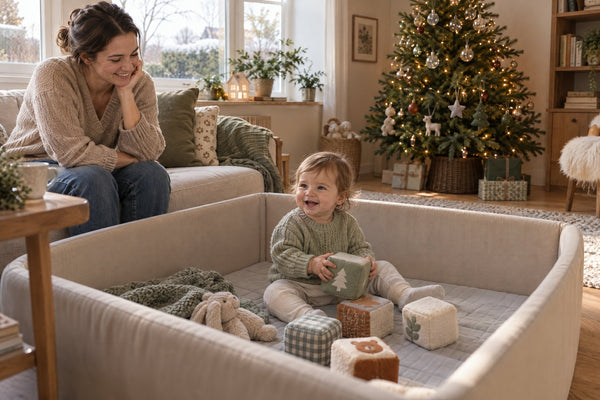
A play yard for play is different from one used for sleep. Our Gentle HugYard is a playpen for supervised play, not a sleep space, so bring a sleep-approved crib or play yard for naps and nights.
Outside, the car and the pool
The AAP's grandparent tips also cover the yard and the driveway: check where the children are before backing out, keep kids away from lawnmowers and power tools, and lock up garden chemicals. If there is a pool, it needs a fence at least 4 feet high with a self-closing, self-latching gate, and an adult in touching distance whenever a child is near the water. A car seat that fits the child and is installed correctly is a must for every ride, even a short trip to the store.
During the visit: the "on watch" rule
Most accidents during family gatherings happen in the gaps, when every adult thinks someone else is watching. Try a simple rule: one adult is "on watch" at any time, and hands over out loud ("You have her now"). Swap every hour so nobody misses the pie.
- Do a 2-minute sweep of the floor after guests arrive and after meals.
- Keep the guest bag spot up high all weekend.
- Check that doors you closed are still closed after people come and go.
- Keep emergency numbers, including Poison Help, in every adult's phone.
After the holidays
If the grandchildren visit often, the quick fixes can become permanent ones: a hardware-mounted gate at the top of the stairs, anchored furniture and latches on the lower cabinets. If you rent the house, our guide to babyproofing without drilling covers what works with no tools and what to ask a landlord. And since children change fast, our babyproofing timeline shows what to expect at each stage, so the house is ready for the next visit too. You can find more about how we think about safety on our safety page.
Frequently asked questions
How do you babyproof a grandparent's house quickly?
Start with medicines and bags, then stairs, then rooms you can close off, then outlets, cords and small objects at toddler height, and finally a safe sleep space. That covers the biggest hazards in about 15 minutes.
Can grandparents use a pressure gate at the top of the stairs?
No. The CPSC says to use only gates that screw to the wall at the top of the stairs. Pressure gates are for doorways and the bottom of the stairs.
Can the baby sleep in bed with Grandma?
No. The AAP advises against bed sharing and against letting a grandchild sleep in a grandparent's bed. Use a crib, bassinet or play yard that meets CPSC standards, with only a fitted sheet.
What is the most important thing to babyproof at Grandma's house?
Medicines. Pill organizers, purses and guest bags are easy for a toddler to reach. Put them up high, out of sight, and ideally locked.
Sources
- American Academy of Pediatrics, HealthyChildren.org: Childproofing Tips for Grandparents
- American Academy of Pediatrics, HealthyChildren.org: Childproofing Your Home for Poisons
- American Academy of Pediatrics, HealthyChildren.org: How to Keep Your Sleeping Baby Safe: AAP Policy Explained
- U.S. Consumer Product Safety Commission: Childproofing Your Home
Sources checked on October 27, 2026.
This guide is general information and is not medical advice. Our products help, and they never replace adult supervision. Talk with your pediatrician about your own child.